

By deepening its partnership with Microsoft and investing further in Microsoft Azure AI Foundry, global engineering consultancy Mott MacDonald is reinforcing its digital backbone and embedding artificial intelligence (AI) across its operations.
Mott MacDonald’s projects are everywhere around us. Some you can see, like bridges connecting communities or large public buildings, but others can be less obvious.
The water in people’s taps; the train that arrives on time; the road that stays open after heavy rain – all depend on infrastructure the employee-owned global engineering consultancy has helped design, deliver and maintain.
And the company brings the same ingenuity towards its own digital operations.
Blueprints to bytes

“Everything we do touches people’s daily lives,” says Nasrine Tomasi, Mott MacDonald’s Head of AI.
“We design and deliver complex infrastructure projects around the world – from water and wastewater networks to electricity grids and major transport systems.”
Her own career has followed the arc of digital transformation over the last two decades. Trained as a water engineer, she began analysing flood and water-quality data in New Zealand nearly 20 years ago.
“We were processing huge volumes of information long before data science became fashionable,” she recalls.
“Back then, we printed out A3 maps; then we started using online maps and downloading data from the internet. That’s when my digital journey began.”
Today, Tomasi leads Mott MacDonald’s AI strategy and information management, ensuring new tools enhance rather than disrupt the trusted methods that have long enabled its people to deliver technical excellence for its clients.
AI in the field
While many companies use AI to automate paperwork, Mott MacDonald’s engineers also apply it to the physical world.
“Infrastructure projects produce enormous amounts of operational data,” Tomasi explains. “We use that data to predict water quality, model floods, and even monitor asset conditions.”
The use of computer vision technology in Mott MacDonald is an example of AI application: algorithms analyse imagery from bridges, dams and motorways to detect cracks or defects, helping to improve safety and reduce costly manual inspections.
Another initiative uses these vision models to identify ‘ash dieback’ – a fungal disease that weakens trees and can lead them to collapse, potentially onto roads or railways.
More recently, the company has used AI to create assistants to help with the complex world of consent management in major infrastructure projects.
“When we build something like a new rail line, we have to consult thousands of people who might be affected,” she says.
“Until recently, people would manually read and categorise every questionnaire response. Now, language models can do that in minutes, capturing all those views and providing explanations for their classifications.”
The outcome, she adds, is both speed and consistency in addressing people’s concerns: “Human assessment is subjective; the AI isn’t perfect, but when it explains its reasoning, people tend to agree with it more.”
EMMA has the answers
Inside Mott MacDonald, a home-grown AI assistant called EMMA – short for Every Mott MacDonald Answer – is redefining how its 20,000 people find information.
Built on Microsoft Azure AI Search and AI Foundry technologies, EMMA draws on the company’s extensive internal knowledge bases.
“Microsoft 365 Copilot is fantastic,” Nasrine says, “but we wanted something that understands Mott MacDonald’s DNA – our projects, policies and technical language.
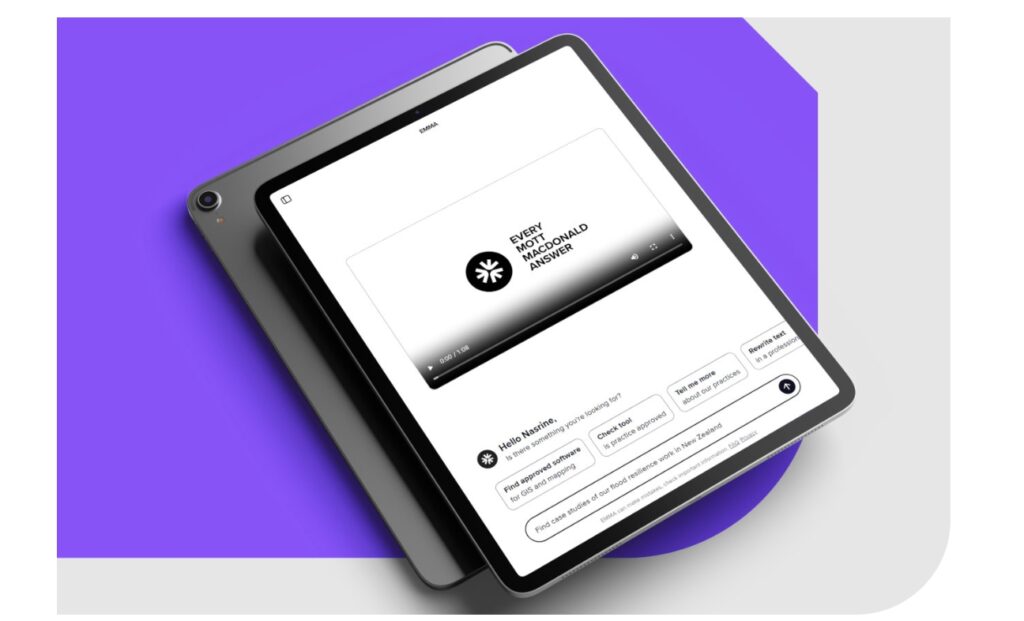
“EMMA is that window into our collective knowledge.”
Employees use it to understand procedures, locate subject-matter experts or check compliance details.
“Our information estate is vast,” she says. “AI makes it searchable in natural language, so people spend less time hunting for answers and more time solving problems.”
Responsible AI, by design
Safety and ethics are non-negotiable in engineering, and Tomasi applies the same lens to digital tools.
“Health and safety are front of mind in our industry,” she says. “We looked at AI through that same perspective.”
But she believes responsible AI isn’t just about restrictions, it’s also about balance.
“You can’t stop AI from happening,” she says. “If governance is too rigid, people will just use AI in the shadows, and that’s less safe. The goal is to find the sweet spot between risk and opportunity.
“Transparency and explainability are everything.”
That philosophy helps clients, too.
“Because we’ve done the hard work on governance, we can demonstrate transparency and explainability,” she says. “That builds trust, and in some tenders it’s even helped us win work.”
AI-confident culture
But “AI can be divisive,” Tomasi admits. “Some engineers worry about sustainability or its impact on jobs.”
To bridge that gap, Mott MacDonald runs AI literacy training and an adoption programme sharing practical examples from real projects. Early results suggest the approach is working. The firm has already empowered more than 3,000 ‘citizen developers’ through its Azure-based digital workspace, unlocking staff creativity while maintaining governance and agility.
David Johnson, the company’s Group Development Director, says deepening the partnership with Microsoft to help deliver this and other new ventures is an important next step that will “enable the democratisation of AI across our business, delivering better outcomes for our clients and the communities they serve.”
Partnering for progress
For Mott MacDonald, Microsoft’s technology is the foundation of that empowerment. Azure provides the scalable cloud infrastructure for AI development, while Microsoft 365 Copilot is rapidly becoming the everyday companion for individuals and project teams.
“Copilot is our main entry point to AI,” she says. “People use it for efficiency and communication – summarising meetings, capturing actions, preparing reviews.”
At the enterprise level, Azure AI Foundry enables more advanced work: training and deploying models, monitoring risk and governance, and delivering custom solutions.
“Our entire AI pathway is supported by Microsoft,” she adds.
Looking ahead, Tomasi’s focus is clear: combine the firm’s deep technical expertise with the power of AI to overcome increasingly complex challenges, making our energy cleaner, our travel easier and our water safer.
“I want to work with our people to bridge the technology and domain expertise we hold and come up with the ideas to shape the future of infrastructure,” she says.
“Investing in our opportunities can actually drive the future of engineering supported by AI.”
Read more about Mott MacDonald’s AI transformation journey here