

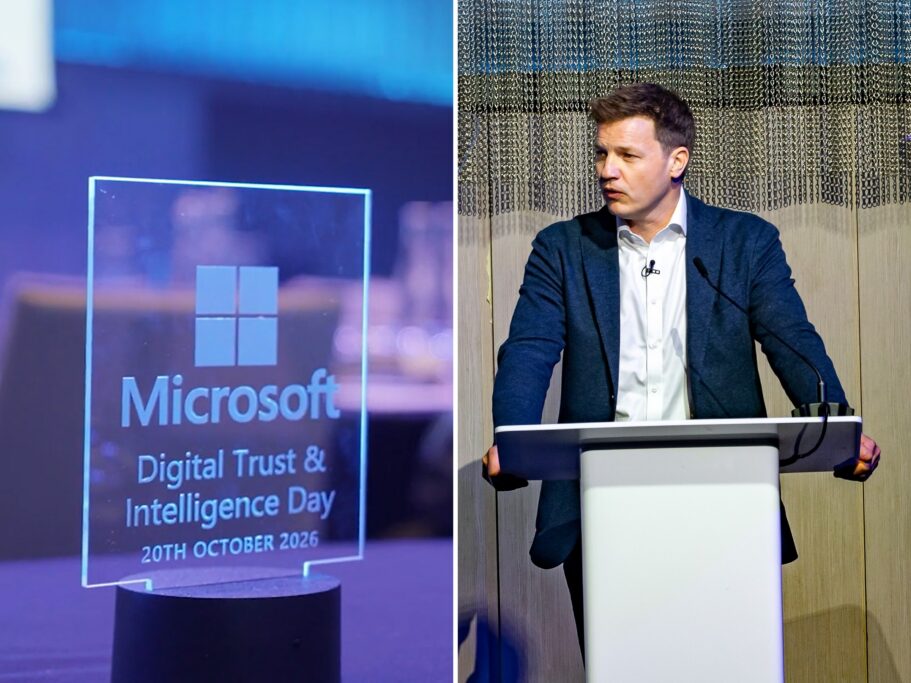
At Microsoft’s inaugural Digital Trust and Intelligence Day in London on 20 October, experts addressed the trust, governance and security challenges for organisations adopting agentic AI.
Speaking to around 200 UK business leaders, Darren Hardman, CEO, Microsoft UK & Ireland reaffirmed his confidence that the UK has an opportunity to lead the AI era.
But achieving that goal will depend on trust, he said.
“Intelligence creates the opportunity, but it’s trust that determines whether organisations can embrace that opportunity and scale it with confidence.”
That trust “has to be engineered and evidenced, and not assumed,” he added.
He also called for a move beyond voluntary self-regulation, with independent testing of frontier AI models before release, obligations to disclose serious AI incidents, and an effective emergency brake if systems move beyond human control.
Secure agentic enterprise
The keynote session, chaired by Jo Miller, Chief Security Officer, Microsoft UK & Ireland, examined how leaders could build and maintain trust around AI agents.
Jeff Bullwinkel, VP and Deputy General Counsel, Microsoft, urged leaders to begin by ensuring their companies could define each agent’s purpose, measure its value and decide which data it should access.
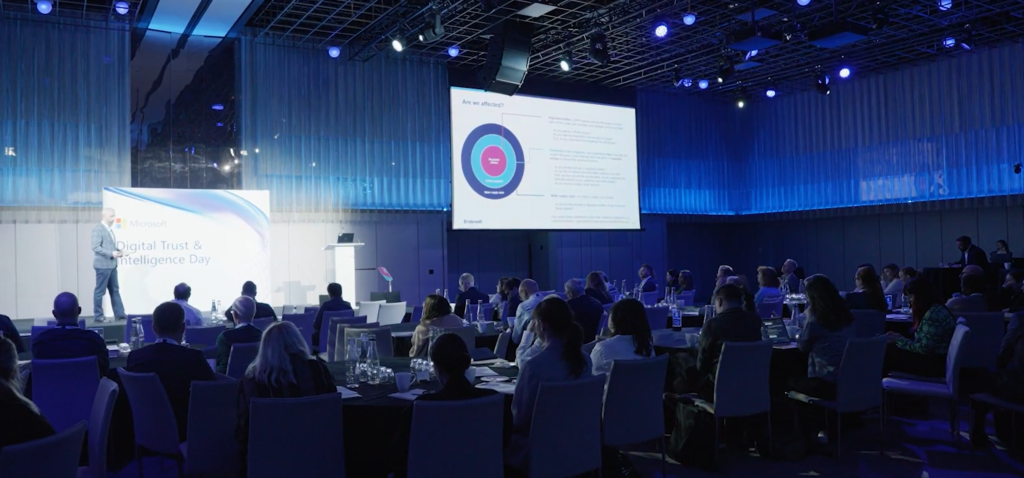
“If you can’t describe in one sentence what the agent is meant to do, you shouldn’t be empowering the agent to do that thing,” he said.
Alym Rayani, VP for AI Security, Microsoft, explained the operational demands: “Agents work around the clock. Humans don’t always work around the clock, right? So you need continuous protection.”
Miller drew the discussion together around three questions: what value organisations wanted to unlock; which controls they needed; and which rules applied, with humans retaining leadership.
Sovereignty by design
Hugh Millward, VP for Corporate Affairs, Microsoft UK & Ireland, and Alistair Speirs, General Manager for Global Platforms, Microsoft, explored digital sovereignty and the common assumption that this is inextricably linked with location. Rather, they suggested, control is the defining feature.
“It doesn’t mean that if you have data within your borders somehow that is operating in a more sovereign way,” Millward said.
“Trust does not slow down AI. It’s what lets us go faster and further“
Speirs outlined how technical, contractual and operational controls could address different risks to sovereignty. Options included public and private cloud, disconnected operation, and switching AI models to maintain continuity.
Sovereignty, they concluded, was a risk decision for boards, with different answers for different cases.
Governance at scale
Microsoft Chief Security Advisers Jon Davies and Lesley Kipling used the relationship between safety systems and driving to examine trust in AI.
Davies’s seatbelt analogy illustrated how safeguards can give people confidence to adopt technology while responsibility remains with humans. We all want to drive and, nowadays, we automatically buckle up before starting the engine. How can we ensure people automatically buckle up before starting their agentic engines, the session asked.
Kipling explained why governance requires continuous assessment of model behaviour, alongside evidence of inputs and outputs for incident investigations. The discussion also addressed business continuity and the demands on people responding to an attack.
“We need to build resilience not just in the technology, but in the people that work for us as well,” Davies said.
The remaining programme got deeper into the specifics and practicalities of regulation, resilience and security.
Sessions covered translating regulatory expectations into action; a Cyber Security and Resilience Bill workshop on incident reporting and risk management; and securing agents through identity, governance and threat protection.
Others examined classifying sensitive data and reducing oversharing, and using AI to map compliance obligations, execute controls and gather evidence.
Darren Hardman aptly summed up the day’s ambition from the start, though, when he told delegates: “Trust does not slow down AI. It’s what lets us go faster and further.”